

Sunday, June 28, 2015

Tuesday, June 16, 2015
Bridlegate crosses: varied fungal resistance
Vine #3 looks like the winner. All vines were treated the same way. All we used for fungicide was Serenade.
Vine #1: Row 3 'East'

Vine #2: Row 3 'West'

Vine #3: Row 6 'East'
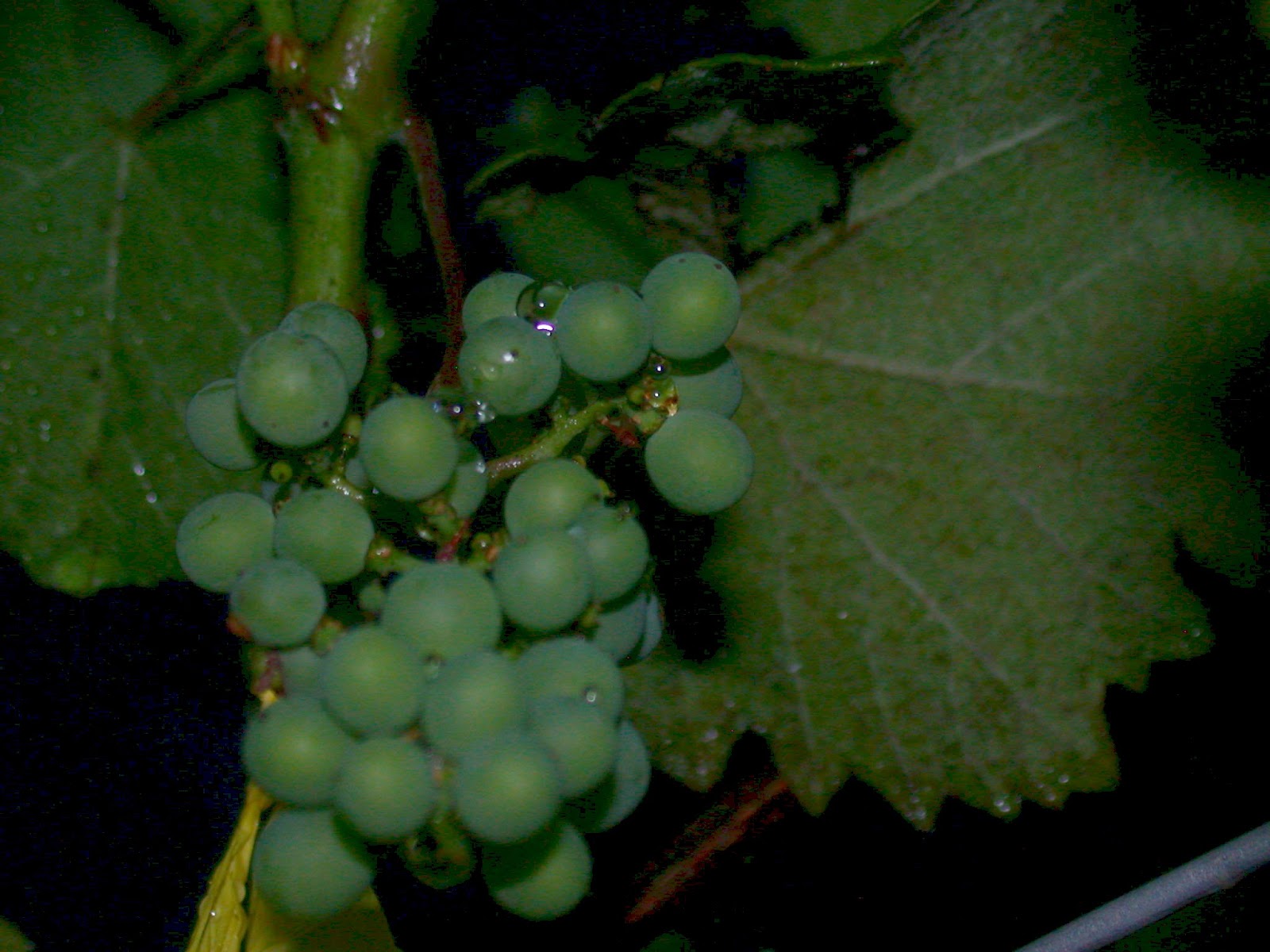
Vine #4: Row 6 'Middle'

Vine #5: Row 6 'West'

Some successful cleft grafts
I made about 24 grafts this year in two sets of twelve. Only 3 survived. I did the first set around mid April, and the second three weeks later. They are about 2 months old

The above diagram of a cleft graft is the technique I used. I wrapped the graft in parafilm, then duct tape. After a month of rain, the duct tape was coming off and I lost a number of grafts when the wood dried out. To hold the duct tape in place, I wrapped yellow marker tape around the grafts. At the time, I had 9 grafts showing some life, only 3 survived the heat of June..
Below are some photos of the successful grafts:
1. Tower Road cinerea on Red River Cinerea (5 week old graft)

2. Tanat on doaniana. 2 month old graft. Some of fungal problems from early May rains.

Red Symphony on doaniana. 2 month old graft.

Sunday, May 17, 2015


Sunday, April 5, 2015
Mission Grape in Texas

There is an interesting and somewhat mysterious history behind the 'Mission grape' in Texas. I have been interested by this grape for years. Today, I came across a history lesson in Vintage Texas that led to Wine Production in El Paso and the Grapevine Inventory of 1775, by Rick Hendricks, New Mexico State Historian. The essay was probably written around 2004.
The article has a somewhat mangled description of the grape variety in use:
"The vine introduced in New Mexico was of the species Vitis vinifera, the so-called Mission grape. This European grape is assumed to have come from the Mónica, a variety common in Spain. Vitis vinifera produces a grape with a high level of sugar, but it is deficient in acid and color, a fact noted by colonial observers who commented on its characteristics. The wine produced from the Mission grape is sweet. The vine is hardy even in harsh climates and is disease resistant."
This should probably read 'The vine introduced in New Mexico by 1660 is now called 'Mission grape', a European grape. The 'mission' grape is thought to be Mónica, a common Spanish variety. known for high levels of sugar, but deficient acid (flat taste) and color (light red). Colonial commentators pointed out these characteristics when tasting New Mexico wine. The wine produced from the Mission grape is sweet. The vine is hardy even in harsh climates and is disease resistant."
The Monica variety is a minor grape native to Sardinia. Made into both a dry, red wine and also a sweet, spicy red wine.
This seems to match the Germplasm Resources Information Network (GRIN) quotes information taken from www.wine-lovers-page.com with regard to the variety 'Mission": "Earliest grape planted in 17th century in what is now the state of California, where it is currently (1997) used to make several styles of wine - 'Criolla' as table wine, 'Angelica', a very long-aged (50+ years) french Ratafia-like fortified wine and some late harvest wines aged for 20+ years that are made from sun-dried grapes. Thought to have arrived in the America's by Spanish conquistadores importation. Known to be identical with the Pais grape widely grown in Chile and thought to originate from the Monica grape of Spain and Sardinia."
Is the link between the 'Monica' and 'Mission' grape valid, though. Compare the two brief descriptions. Do they match? I think the link is weak.
Another clue can be found in the Hendricks article when the talks about a law forbidding harvesting of grapes until September 15: "The grapes were usually ripe near the end of July. Ideally, they were left on the vine until October so that they could attain maximum sweetness. In fact, by law they could not be harvested until 15 September."
This suggests the grapes were allowed to raisin, probably because they were of limited use as a wine grape until drying out on the vine (turning into raisins) had raised their sugar content enough for wine making. This doesn't sound like Monica.
GRIN's 'Mission' page actually tells two stories. Here is the other one:
"Per Hedrick (1911. The Grapes of New York. unspecified pg. 489): "The exact origin of Mission is unknown but is believed to have originated in the remote Missions of northern Mexico at a time when grape-growing was forbidden by Spain. The variety was introduced into California at a very early day and was raised by the Mission fathers, hence the name. Mission is believed by some to be a hybrid between Vinifera and Girdiana. Vigorous; canes short-jointed, dull dark brown to grayish; leaf above medium size, slightly oblong, five-lobed; stamens erect; clusters slightly shouldered, loose, distinctly compound; berries medium, round; skin thin, purplish-black with heavy bloom; flesh tender, vinous, sweet; very good; ripens with Concord in Texas; said to be imperfectly self-fertile."
Note that in this version of the story, Mission is a cross of European and a vine native to Southern California (Girdiana). This is problematic, too. The 'mission' vine came to California, it wasn't bred there.
What is a more reasonable place for 'Mission' to be bred? Probably the older missions of northern Mexico. Just to confuse things a bit more, 'Carignane' seems to be another name for 'Mission'. Of this, Hedrick (1911) wrote: ""The exact origin of Mission [Carignane] is unknown but is believed to have originated in the remote Missions of northern Mexico at a time when grape-growing was forbidden by Spain."
This may be of interest to few outside of Texas, but the history and pedigree of the 'Mission' grape are important element of Texas viticultural history. To really solve this, we need a DNA marker study to identify the parentage of Mission.
Here is my speculation on the subject (If I haven't put more than enough here already). The vines seem to be cuttings from older church vineyards in Mexico far south of New Mexico. At these locations, Pierce's Disease (PD) if endemic. Vines that could survive PD would be quickly popularized, and sent to new churches/missions such as the ones in New Mexico.
Given the contemporary commercial interest in European vines, it isn't surprising that the North American heritage could easily be forgotten. It think it telling that the breeders of the 1890 era thought Mission a cross of European and North American stocks, but more recent authors call it European.
Think about it. How long would it take for a cutting to be shipped from Spain to New Mexico (assuming this was the route used)? I doubt the cutting would survive since there was no way to cool it during the entire journey. Shipment from a Mexican vineyard seems far more likely, and this would require PD tolerance.
Sunday, March 22, 2015
French 'no spray' vineyard
The No Spray Vineyard
'Viticulture in a perilous state right now, like a house with termites in the beams,' says Pugibet. 'There isn't a chemical solution to it, and organic farming isn't the answer, because metals like copper will build up in the soil over time, and have a damaging effect on the aromatics of white wine particularly. I worry that if things carry on as they are, in 15 years winemakers will be faced with a situation where certain molecules will be banned outright and they will be left with no treatments against vine disease.'Without pointing it out directly, the article contrasts 'corporate science' and terroir. Without grass roots breeding programs like the one described in the article, terroir is waning.
Hat tip: John Barnett
published in Decanter China
The 4 bottle announcement
On the March the 1st, during a family get together, I decided to announce the Mills Vineyard would make 4 bottles of wine in 2015.
This came up while talking to my daughter and her teenage sons. The conversation went something like this:
Julie: How's the vineyard doing?
Me: We made 2 tablespoons of grape juice last year, but this year is going to be different.
Grandsons: Subdued laughter.
My wife rolled her eyes. She has been through 8 years of attempted harvests, and 2 liters of juice is the best I've done.
Me: In fact, I think we can make 4 bottles of wine this year.
I had been doing the math and already knew the dormant spray was going to help with the frost problem, but when '4 bottles of wine this year' came out of my mouth, it was a bit of a surprise. Earlier that week, I think making one bottle was the extent I allowed my imagination to wander.
It is surprising how setting a goal will focus the mind. I had not given much thought to wine making. My problem was simply getting 20 pounds of fruit harvested. Of course, saying 'we are going to make 20 pounds of grapes carries no emotion.
This came up while talking to my daughter and her teenage sons. The conversation went something like this:
Julie: How's the vineyard doing?
Me: We made 2 tablespoons of grape juice last year, but this year is going to be different.
Grandsons: Subdued laughter.
My wife rolled her eyes. She has been through 8 years of attempted harvests, and 2 liters of juice is the best I've done.
Me: In fact, I think we can make 4 bottles of wine this year.
I had been doing the math and already knew the dormant spray was going to help with the frost problem, but when '4 bottles of wine this year' came out of my mouth, it was a bit of a surprise. Earlier that week, I think making one bottle was the extent I allowed my imagination to wander.
It is surprising how setting a goal will focus the mind. I had not given much thought to wine making. My problem was simply getting 20 pounds of fruit harvested. Of course, saying 'we are going to make 20 pounds of grapes carries no emotion.
Thursday, March 19, 2015
Happy first day of spring!

I've been spraying dormant oil on a 2 week schedule, with 6 selected vines getting sprayed on a 1 week schedule. It seems to be doing a good job of delaying bud burst. Also, it seems to be differentially impacting buds such that there is a much wider spread in 'start times'. Combined with my late pruning (no pruning done, yet), I think my chances of getting at least a few primary buds to survive the frost season (Feb 15 to April 15) is much, much better.
Based on the forecast, there is a fair chance of a freeze here on April 3 and 4th. The forecast is for 43 and 44, but I'm often 10 degrees cooler.
Below is a record of low temps in my vineyard. The temps come from Opossum Hollow, about 2 miles up the river. I've spot checked my vineyard temps, and they match very well. Out of 8 years, there was only 1 spring without a freeze between 3/29 and 4/15. The chances this early bud will survive are low, but a lot of other buds will be fine. Those late buds will be the ones that produce the next generation of grape seeds here.

Sunday, March 8, 2015
Our lives follow the grapes
In the Cellar: Our lives follow the grapes (March 6, 2015)
Michelle Fey, lab director, talking about how the seasons of her life and the seasons of grapes parallel and illuminate each other.
Michelle Fey, lab director, talking about how the seasons of her life and the seasons of grapes parallel and illuminate each other.
Wednesday, March 4, 2015
Typical 1st week of March - temp 26F and falling
As I write, the temperature in the vineyard is 26 F and falling. Sleet was expected tonight, and arrived on schedule.
Last night I noticed a hole in the greenhouse roof. I'm glad I check on the seedlings before going to bed.
searching for a 2 liter auto-vinification system
Tonight, I've continued my search for a system/equipment combo capable of turning 2 liters of grape juice into a representative bottle of wine.
from: Showstoppers From SIMEI and Enovitis
auto-vinification tank systems: automated cap management, temperature control and the handling of lees, seeds and pomace
Automated fermentation systems have a number of advantages over manual pump overs.
1. labor savings,
2. automated systems can deliver precise and repeatable regimens day and night
3. respond to tank temps, Brix level, carbon dioxide evolution rate, etc.
4. Cross-contamination among tanks is avoided, (line of sight guesses about pipe connections is dangerous)
DEFRANCESCHI FERMENTERS

punchdown-vs-pumpover
 "Pumpovers can extract higher amounts of tannin in a wine depending on the frequency and force. Some pump over systems are basically wine sprinklers, offering a gentler extraction and some aggressively stir up the fermentation tank. For larger fermentation tanks in commercial operations, much needed oxygen comes through a pumpover device.
Punch downs, on the other hand, are a very delicate way of stirring a wine. They keep skins from getting too extracted and little to no amount of added oxygen in the fermentation. Punch downs are typically done by hand and are more popular with non-interventionist winemaking."
other pages of interest, but no more time tonight:
https://prezi.com/kikrobseu37j/mexican-wine-chain-analysis/
http://nobleroute.com/about/
from: Showstoppers From SIMEI and Enovitis
auto-vinification tank systems: automated cap management, temperature control and the handling of lees, seeds and pomace
Automated fermentation systems have a number of advantages over manual pump overs.
1. labor savings,
2. automated systems can deliver precise and repeatable regimens day and night
3. respond to tank temps, Brix level, carbon dioxide evolution rate, etc.
4. Cross-contamination among tanks is avoided, (line of sight guesses about pipe connections is dangerous)
DEFRANCESCHI FERMENTERS
punchdown-vs-pumpover
Punch downs, on the other hand, are a very delicate way of stirring a wine. They keep skins from getting too extracted and little to no amount of added oxygen in the fermentation. Punch downs are typically done by hand and are more popular with non-interventionist winemaking."
other pages of interest, but no more time tonight:
https://prezi.com/kikrobseu37j/mexican-wine-chain-analysis/
http://nobleroute.com/about/
Monday, March 2, 2015
An alternative view of the Loire salons:

...
" if we agree that natural winemaking favors the inherently communal concept of terroir, rather than the more individualist, auteur-focused winemaker culture that obtains in most modernised New World regions, then we should admit that European natural wine buyers, and in turn their clientele, can learn very little from the isolated examples of one winemaker or one importer."
from Not Drinking Poison in Paris
Also see:
Church wine : Tasting in Angers (Loire)
NY Times take on Loire natural wines
The first of the weekend tastings, Renaissance, in Angers on Jan. 31 and
Feb. 1, brought together producers who make organic, pesticide-free,
but not necessarily sulfite-free, wines. ...
If
the Renaissance salon was the most established of the nonpesticide
tastings, Les Anonymes, a short distance away, was the most radical and
uncompromising...
In
Saumur, about 26 miles away, a much larger group of nearly 200
winemakers from 15 countries displayed its wares in a warren of cold,
damp troglodyte caves. Called La Dive Bouteille, it has become the
world’s largest annual natural wine exposition, with 3,000 visitors this
year....
The
article lists the three largest pesticide users as the United States,
Japan and France, and suggests restricting pesticide use is gaining
popularity. Despite this:
"The pesticide and big-agriculture lobbies are strong, resisting any initiative that could affect farm yields, so there is little political will to take risks. In late January, the French agriculture minister, Stéphane Le Foll, announced that a government pledge to cut pesticide use in half by 2018 would be delayed until 2025..."
"The pesticide and big-agriculture lobbies are strong, resisting any initiative that could affect farm yields, so there is little political will to take risks. In late January, the French agriculture minister, Stéphane Le Foll, announced that a government pledge to cut pesticide use in half by 2018 would be delayed until 2025..."
...
Sunday, November 16, 2014
Why did I start breeding grapes?
There are many mustang grapes on my property. They make lots of grapes each year, but they taste like chili peppers.
In 2005, I decided to grow some interesting grapes I found in a local nursery. One was called Himrod, another was Thompson seedless.
My neighbors said I couldn't grow grapes on a Texas river bank, especially the river I lived on. I needed to be up on a hilltop, where frost was rare.
They were right about the frost. I had late frosts every year. After a late frost, I would want to cry. Almost all my vines would lose their flowers. No matter how good I got at keeping them healthy the rest of the year, there would be little or no fruit.
After losing the 2009 crop to a late frost, I came across some vines flowering on a river bank 30 miles from my home. I was on my way to visit a place called 'Sand Hill', but to get there we crossed a number of creeks. One had these magnificent flowering vines.
When I tasted the fruit that fall, it was small, but very good. The obvious solution was breeding.
Why cry? As a breeder, the late frosts are just helping me select good vines.
In 2005, I decided to grow some interesting grapes I found in a local nursery. One was called Himrod, another was Thompson seedless.
My neighbors said I couldn't grow grapes on a Texas river bank, especially the river I lived on. I needed to be up on a hilltop, where frost was rare.
They were right about the frost. I had late frosts every year. After a late frost, I would want to cry. Almost all my vines would lose their flowers. No matter how good I got at keeping them healthy the rest of the year, there would be little or no fruit.
After losing the 2009 crop to a late frost, I came across some vines flowering on a river bank 30 miles from my home. I was on my way to visit a place called 'Sand Hill', but to get there we crossed a number of creeks. One had these magnificent flowering vines.
When I tasted the fruit that fall, it was small, but very good. The obvious solution was breeding.
Why cry? As a breeder, the late frosts are just helping me select good vines.
Saturday, October 25, 2014
TATIB foundation (South Africa)
The Air That I Breathe Foundation (TATIB)
"Worldwide 25 million people are poisoned by pesticides every year"
"Worldwide 25 million people are poisoned by pesticides every year"
'Incurable' grape disease devasting French vineyards
French winemakers demand action on 'incurable' grape disease devastating vines
"French winemakers have demanded emergency funding to deal with an "incurable" grape disease which they fear could become as devastating as a 19th-century plague that almost destroyed the nation's vineyards...The fungal disease, esca, has infected 13 per cent of France's vines this year, costing the industry more than €1 billion (£790 million). "
More on the Esca (Grape Measles)
Pathogen: Nine species of fungi in the genus Phaeoacremonium.
SYMPTOMS
Affected leaves display small, chlorotic interveinal areas that enlarge and dry out. Foliage symptoms are frequently called "esca." In red varieties dark red margins surround the dead interveinal areas. Severely affected leaves may drop and canes may dieback from the tips. Symptoms may occur at any time during the growing season but are most prevalent during July and August. On berries, small, round, dark spots, each bordered by a brown-purple ring, may occur. These spots may appear at any time between fruit set and ripening. In severely affected vines the berries often crack and dry on the vine or are subject to spoilage.
What if esca disease of grapevine were not a fungal disease?
This article takes a systemic view "Consequently the presumed esca-associated fungal pathogens are most likely saprobes decaying already senescent or dead wood resulting from intensive pruning, frost or other mecanical injuries as grafting. The cause of esca disease therefore remains elusive and requires well executive scientific study. These results question the assumed pathogenicity of fungi in other diseases of plants or animals where identical mycota are retrieved from both diseased and healthy individuals."
"French winemakers have demanded emergency funding to deal with an "incurable" grape disease which they fear could become as devastating as a 19th-century plague that almost destroyed the nation's vineyards...The fungal disease, esca, has infected 13 per cent of France's vines this year, costing the industry more than €1 billion (£790 million). "
More on the Esca (Grape Measles)
Pathogen: Nine species of fungi in the genus Phaeoacremonium.
SYMPTOMS
Affected leaves display small, chlorotic interveinal areas that enlarge and dry out. Foliage symptoms are frequently called "esca." In red varieties dark red margins surround the dead interveinal areas. Severely affected leaves may drop and canes may dieback from the tips. Symptoms may occur at any time during the growing season but are most prevalent during July and August. On berries, small, round, dark spots, each bordered by a brown-purple ring, may occur. These spots may appear at any time between fruit set and ripening. In severely affected vines the berries often crack and dry on the vine or are subject to spoilage.
What if esca disease of grapevine were not a fungal disease?
This article takes a systemic view "Consequently the presumed esca-associated fungal pathogens are most likely saprobes decaying already senescent or dead wood resulting from intensive pruning, frost or other mecanical injuries as grafting. The cause of esca disease therefore remains elusive and requires well executive scientific study. These results question the assumed pathogenicity of fungi in other diseases of plants or animals where identical mycota are retrieved from both diseased and healthy individuals."
Pesticide warning in France
French winegrowers warned over pesticide use
"A French winegrower, who died after contracting leukaemia becoming the first farmer to have his illness officially linked to the pesticides he used for years on his crops, has spoken from beyond the grave giving a warning to the industry....
He is among 40 or so farmers in France whose illnesses have now been
officially linked to their profession and the pesticides they have sprayed
on the land by the French agricultural public health body.
Speaking shortly before his death, Mr Chenet said: "When I got the
hospital I saw the same company whose name was on the pill box (as the one
that made the farming products). I said: 'It can't be true; the same group
that poisoned me is now treating me."
Saturday, October 18, 2014
Getting familiar with the term 'Tex-French Vine'
It seems a lot of wine lovers equate 'American grapes' with Labrusca. Labrusca grows in the US Northeast, not in Texas. The most famous labrusca, Concord, was bred in Massachusetts. While many Americans grow up with Concord grape juice, and love it, the wine it produces is famous for its unpleasant 'foxy' taste, which I describe to my friends as 'a sniff of kerosene'.
A month ago, some of my grape breeding friends were lamenting this, quoting supposedly well read individuals and suggesting ways of meaningfully correcting them. These comments greatly troubled me. I've heard them myself, and it wounds my Texas pride. Lubrusca won't even grow in my part of Texas.
To some degree, I blame 'French American' vines for this sad state of affairs. Early French crosses with native American vines focused on labrusca and an extremely healthy American cross from Missouri, 'Jaeger 70'. Jaeger 70 was created gy by Hermann Jaeger of Neosho, Missouri. Its parents were vines from two different wild American varieties: Lincicumii and Rupestris. Lincicumii has very large clusters and large berries. Rupestris is very sweet. Together, you get a relatively sweet, healthy vine that resists a variety of American pests that were rampaging through France when it was bred in the 1880s. When crossed with European vines, the progeny could ignore the invading American pests, and produced a passable wine.
Unfortunately, the Missouri Lincicumii imparted a smoky twang to it descendents for generations. Personally, I don't like it. It isn't as bad as labrusca, but I avoid it. Some people like it. It just isn't my style. Still, I've got several of its descendents in my vineyard. They are very healthy, but my idea is to stick with non-tang specimens, of which several varieties of wild Texas and European grapes provide many fine examples. Trying to grow grapes in the Texas heat, and every grape disease known to man isn't easy. The descendents of Jaeger 70 were the first vines I grew that liked it here in Glen Rose, Texas.
Hopefully, you are catching my drift by now. New England Labruscas make wines that remind me of kerosene. Missouri vines are better, but still remind me of a smoky cigar (which some like a great deal). Let me get to the point, native American wines get better the closer you get to Texas.
To help me spread the good news, the idea of 'Tex-French' vines came to mind, and I posted something here about it 2 weeks ago. I liked the contrast between 'Tex-French' and 'French American'. It is a bit ironic and romantic for Texans. For a few years, Texas was part of France, and we like to remind Northerners our roots are different than theirs. There is already a 'Tex-French' cuisine here, and heck, we saved the French wine industry 100 years ago, so its sort of a family thing.
To help bring Texas grapes to the attention of future wine lovers, I wanted to create a label that clearly differentiates North-Eastern US viticulture from Texan viticulture.
Here is the idea:
1. 'Tex French' has nothing to do with Lubrusca, nor anything to do with Jaeger 70.
2. 'Tex-French' vines were bred in France between 1880 and 1940.
3. The American side of the pedigree is entirely Texan.
So, why haven't you heard of the great native Texas vines?
Fortunately, the brave French grape breeders 100 years ago crossed a number of wild Texas vines with their local vines.
Unfortunately for these new vines, the stout Frenchmen doing all this grape, lived in a place where wild Texas grapes never got enough heat to ripen. Southern France is as far north as Philadelphia. Sweet Texas vines produced 'sour grapes' if grown in New York or France. Texas grapes were dismissed. The only purpose they were thought suited to was root-stock. Their fruiting capabilities were ignored. A status they still suffer.
Here are some examples:
41B Millardet (Female)
Fercal (female, crosses already in vineyard)
Montpellier 333 EM (Male)
Richter 99 (Male)
Ruggeri 140 (Male)
Possible example (The vine likes it here in Texas, but the North American side's source is unknown)
1202 Couderc (Perfect)
Alicante Ganzin (Perfect)
Ganzin #1 (AxR1) (Male)
A month ago, some of my grape breeding friends were lamenting this, quoting supposedly well read individuals and suggesting ways of meaningfully correcting them. These comments greatly troubled me. I've heard them myself, and it wounds my Texas pride. Lubrusca won't even grow in my part of Texas.
To some degree, I blame 'French American' vines for this sad state of affairs. Early French crosses with native American vines focused on labrusca and an extremely healthy American cross from Missouri, 'Jaeger 70'. Jaeger 70 was created gy by Hermann Jaeger of Neosho, Missouri. Its parents were vines from two different wild American varieties: Lincicumii and Rupestris. Lincicumii has very large clusters and large berries. Rupestris is very sweet. Together, you get a relatively sweet, healthy vine that resists a variety of American pests that were rampaging through France when it was bred in the 1880s. When crossed with European vines, the progeny could ignore the invading American pests, and produced a passable wine.
Unfortunately, the Missouri Lincicumii imparted a smoky twang to it descendents for generations. Personally, I don't like it. It isn't as bad as labrusca, but I avoid it. Some people like it. It just isn't my style. Still, I've got several of its descendents in my vineyard. They are very healthy, but my idea is to stick with non-tang specimens, of which several varieties of wild Texas and European grapes provide many fine examples. Trying to grow grapes in the Texas heat, and every grape disease known to man isn't easy. The descendents of Jaeger 70 were the first vines I grew that liked it here in Glen Rose, Texas.
Hopefully, you are catching my drift by now. New England Labruscas make wines that remind me of kerosene. Missouri vines are better, but still remind me of a smoky cigar (which some like a great deal). Let me get to the point, native American wines get better the closer you get to Texas.
To help me spread the good news, the idea of 'Tex-French' vines came to mind, and I posted something here about it 2 weeks ago. I liked the contrast between 'Tex-French' and 'French American'. It is a bit ironic and romantic for Texans. For a few years, Texas was part of France, and we like to remind Northerners our roots are different than theirs. There is already a 'Tex-French' cuisine here, and heck, we saved the French wine industry 100 years ago, so its sort of a family thing.
To help bring Texas grapes to the attention of future wine lovers, I wanted to create a label that clearly differentiates North-Eastern US viticulture from Texan viticulture.
Here is the idea:
1. 'Tex French' has nothing to do with Lubrusca, nor anything to do with Jaeger 70.
2. 'Tex-French' vines were bred in France between 1880 and 1940.
3. The American side of the pedigree is entirely Texan.
So, why haven't you heard of the great native Texas vines?
Fortunately, the brave French grape breeders 100 years ago crossed a number of wild Texas vines with their local vines.
Unfortunately for these new vines, the stout Frenchmen doing all this grape, lived in a place where wild Texas grapes never got enough heat to ripen. Southern France is as far north as Philadelphia. Sweet Texas vines produced 'sour grapes' if grown in New York or France. Texas grapes were dismissed. The only purpose they were thought suited to was root-stock. Their fruiting capabilities were ignored. A status they still suffer.
Here are some examples:
41B Millardet (Female)
Fercal (female, crosses already in vineyard)
Montpellier 333 EM (Male)
Richter 99 (Male)
Ruggeri 140 (Male)
Possible example (The vine likes it here in Texas, but the North American side's source is unknown)
1202 Couderc (Perfect)
Alicante Ganzin (Perfect)
Ganzin #1 (AxR1) (Male)
Saturday, October 4, 2014
Tex-French wine
I find it interesting to bring 1st generation Tex-French grape vines back to Texas. They are a subset of vines now known as 'French American' vines. The most well known of the French-American vines trace their ancestry back to the famous Jaeger 70 vine bred by Herman Jaeger sometime between 1880 and 1895. Jaeger 70 (aka Munson) was created by crossing two wild vines found in the Ozarks, one a Lincecumii (aka Post-oak vine) vine, the other being rupestris (aka July, sand or sugar grape). Jaeger 70 was incredibly healthy, and produced abundant and large clusters. Jaeger 70 is still around and still be tasted if you know the right people. It has a distinctive smoky, tar taste that is hard to mask. It passed this taste to its descendants.
Unfortunately for Texans, the French favored crossing foxy Lubrusca (found in the Northeast), and smokey-tar tasting Jaeger 70. Most Europeans think all grapes in America taste like Jaeger 70.
It isn't so. Texas cinerea and rupestris don't have the tar and fox of the upper Mid-west and east coast.
No one really tried to work with sweet Texas vines. They had very small berries. All Europe cared about was healthy root stock. They didn't need to improve taste. That job had been finished around 1650 when Cabernet Sauvignon and Chardonnay were bred.
Meanwhile, in Texas, we don't need root stock, we need bigger fruit, but all anyone thought the French-American vines could be used for was root stock. For example, Fercal (rupestris x vinifera) is a popular rootstock). I'm uses Fercal for fruit.
I find the idea of breeding root stock here in Texas rather odd. The native grapes do fine and we have every grape disease known to man. Instead, we need fruit breeding! For some reason, we felt we needed to copy the French. Since the French were doing root stock breeding, it seems that is what the state and university system wanted to do.
I don't know about you, but it is an irony that I enjoy reflecting on this while drinking a glass of wine in my vineyard.
Anyway, here is to Tex-French wine!
Tex-French is already a popular taste:
Unfortunately for Texans, the French favored crossing foxy Lubrusca (found in the Northeast), and smokey-tar tasting Jaeger 70. Most Europeans think all grapes in America taste like Jaeger 70.
It isn't so. Texas cinerea and rupestris don't have the tar and fox of the upper Mid-west and east coast.
No one really tried to work with sweet Texas vines. They had very small berries. All Europe cared about was healthy root stock. They didn't need to improve taste. That job had been finished around 1650 when Cabernet Sauvignon and Chardonnay were bred.
Meanwhile, in Texas, we don't need root stock, we need bigger fruit, but all anyone thought the French-American vines could be used for was root stock. For example, Fercal (rupestris x vinifera) is a popular rootstock). I'm uses Fercal for fruit.
I find the idea of breeding root stock here in Texas rather odd. The native grapes do fine and we have every grape disease known to man. Instead, we need fruit breeding! For some reason, we felt we needed to copy the French. Since the French were doing root stock breeding, it seems that is what the state and university system wanted to do.
I don't know about you, but it is an irony that I enjoy reflecting on this while drinking a glass of wine in my vineyard.
Anyway, here is to Tex-French wine!
Tex-French is already a popular taste:
Subscribe to:
Posts (Atom)